How I Survived an Avalanche on Grosser Priel
Despite hiking in the mountains for the past 20 years — from rock climbing and ski touring to multi-pitch climbing — the avalanche I recently experienced caught me off guard and reminded me that in the mountains you must stay alert at all times.
It all happened in spring 2026 below Grosser Priel in the Totes Gebirge mountains in Austria.
There were four of us. Two adult fathers, each with his son. Apart from a torn ligament in one knee and a strained groin, we all came out alive, unharmed, and with a lesson learned.
Brief summary
The avalanche hit us around 10:00 AM, roughly 1.5 hours into the climb above the Priel-Schutzhaus hut. It carried us down about 90 vertical metres, where we ended up on its surface. People at the hut were watching; I immediately received a phone call, and we were airlifted first to the hut and, after a police interview, down to the car park.
In this article I want to capture the lessons and facts for my own future reference. At the end I include coverage from the media.
Video I filmed right after the avalanche ended
What actually happened
We slept at the Priel-Schutzhaus hut. Avalanche risk level 2 in the evening, and 2/3 in the morning at an altitude of 1,500 m above sea level.
In the evening we got talking with the locals — I said the experience had to be intense, and they replied that what matters is that it leaves a mark on you. A lesson in listening carefully and paying attention to what kind of wishes you put out into the world — yourself and others.
We set off in the morning around 8:30. Clear blue sky. We moved slowly. Every now and then we heard a rumble — small avalanches, far from us, sliding down. First warning sign.
We were still on a slope clear of slide paths.
Gradually we moved further and further under the left ridge. I know now — yes, I wanted to follow the winter route, yes, I wanted to keep more to the right. I said so repeatedly. The key point is that I did nothing about it and went along with the group.
I’m not saying it’s certain the avalanche would have missed us, but we wouldn’t have been directly below the slope and right in its path. Maybe.
Suddenly there was a loud rumble directly on the left slope above us. The avalanche stopped several hundred metres above us.
We barely had time to catch our breath before the next one came — and this time it reached us.
My first words were — well, I’ve cocked this up. And I already felt it knock me to the ground. I felt the heavy mass of snow pressing down on me. I was afraid my crampons would pierce my legs. Once I saw light, but like in a tunnel it went dark again just as suddenly.
When I saw light a second time, I made a swimming motion and suddenly had half my body on the surface. I immediately shouted my son’s name at the top of my lungs. He answered.
Great, he’s alive. I started sorting myself out. I was on moving snow. My second sensation was that the snow beside me was stationary. And the third was that the snow in front of me was dropping away somewhere below. And then it was just instinct and action — I rolled over about twice and I was on snow that wasn’t moving.
When I stood up, the first thing I saw was the other father. He was standing on a strap, telling me his boot had been ripped off and his knee was in a bad way.
The kids were above us.
I got them down to us. Just then I got a call from the hut keeper’s girlfriend. She said they had seen everything, asking how we were and whether to send a helicopter.
I said: wait, I’ll give them a moment and something sweet, find out what injuries we have and get back to you.
After a few minutes and some sweets (that was the only sugar I could find in that state) we confirmed we wanted the helicopter. We had Alpenverein membership, so that was fine.
She asked me — do you know how to guide a helicopter in? I said no. You stand in a Y shape with your arms and until you get a different instruction from the pilot or crew, you just stand and wait.
And what should the others do, I asked. They should crouch down and hold onto their backpacks.
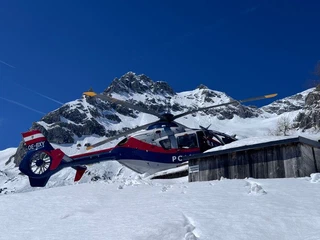
The helicopter arrives. I think to myself — well, if we haven’t been killed so far, now we’ve got a second chance to be — it’ll trigger a new avalanche or those rotor blades will chop me to pieces.
Fortunately they got us to the hut in two runs. The father with the injured knee went straight to hospital. I stayed at the hut with the two kids and waited for the police. The hut keeper gave us schnapps and moral support. Tourists who had been planning to head for the summit that day, seeing what happened, stopped, had a Radler, and turned back down.
The last difficult moment was when the police officer interviewed me — why did you go there. Did you have avalanche equipment? Did you know what could happen?
And at the end he told me to appreciate how incredibly lucky we were, and that we should learn from it. Seeing my shattered expression, he leaned towards me and added: I go into the mountains too, and I know you can’t do it without risk.
He arranged a helicopter lift down to the car park for us. I asked him whether we would have to pay. Since the avalanche had come from above us — no. From the car park we drove to the hospital. I saw my son embrace his father, who was standing in the hospital lobby on crutches.
On the way home my son said — I know now what matters and what matters less. And at the same time he noticed how different people reacted when we told our closest ones what had happened.
I know I’ve been given a second chance.
Thank you, God. I will do something good with it.
A few days later, when we called each other, we all agreed that on the second and third day we had felt as though we’d been run over by a steamroller — which fortunately has left none of us with any lasting effects.
Media coverage
What really surprised me was that barely an hour after the police interview, after we had been airlifted back down, the hut keeper’s girlfriend sent me a link to the Austrian news site nachrichten.at (PDF version in English and German).
The author is Judith Pointner. It contains almost the exact wording of what the officer was writing down in pen on paper during the interview. The police actually sent it to the journalists.
About 30 minutes later the story, already containing an error (who had snowshoes and who had crampons), appeared on the Czech site IDNES.cz and then spread further — sometimes correctly, sometimes with the error intact.
17:32 Obrovské štěstí českých a slovenských turistů v Rakousku: lavina je „vyplavila" – Idnes.cz, PDF export
17:34 Česko-slovenskou skupinu v Rakousku strhla lavina, jeden lehce zraněný – DenikN.cz, PDF export
20:21 Lavina v Rakousku strhla čtveřici českých a slovenských turistů. Sami se z ní zvládli vyprostit – iRozhlas.cz, PDF export
6. 4. 2026, 10:21 V Rakousku smetla lavina skupinu z Česka a Slovenska. Měli obrovské štěstí – TN.cz, PDF export
A few photos
The first avalanche — that one didn’t reach us.
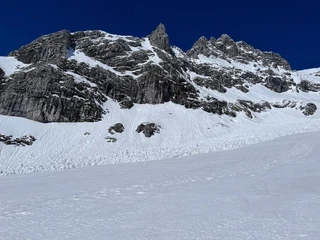
This is our avalanche.
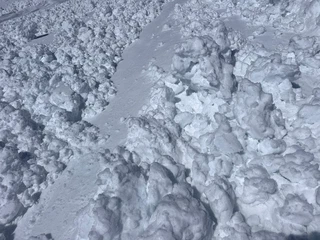
And us in it. I’m calling the hut and arranging the rescue helicopter.
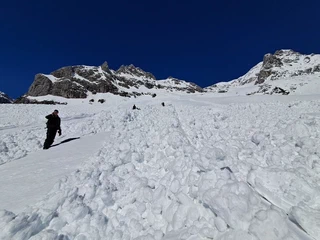
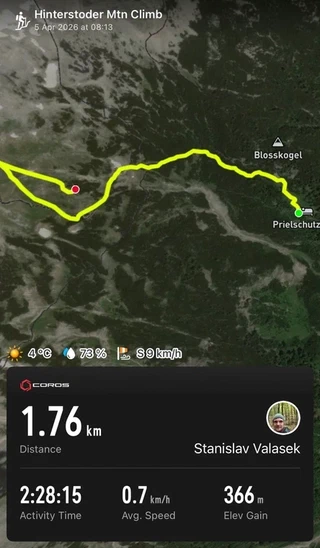
Recording from my Coros Vertix watch — so I know exactly how many vertical metres it took us.
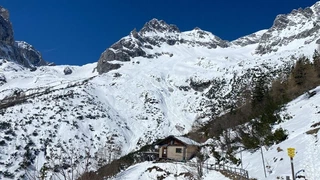
And this photo is already from the hut.
Lessons learned
- Always carry avalanche equipment into snow terrain (beacon, shovel, probe).
- Don’t let the group override your judgment. Explain why you want a different route, and if there’s no agreement and you can’t continue safely, turn back.
- If there are small avalanches around you, turn back — especially when you are with people you are responsible for.
- Check the avalanche forecast and if the risk has gone up even one level, be on high alert.

I am currently Delivery Manager of the Federated Learning team at Siemens Healthineers, leading the development of a cloud-based platform integrated with edge hardware for training medical AI models.
I am also the creator of Find a Coach and KiCoMa. Find a Coach is dedicated to empowering the coaching community. Both projects serve as my hands-on laboratory to stay at the forefront of emerging technologies and modern software development.